Friday, June 10, 2016

A Month-Plus After the Quake

About a month after the April 16 quake, on May 18, we decided to venture up to Manta to the Supermaxi. We had donated supplies for the convoys going that direction, but we had decided to stay out of the way. All reports were that things were cleaned up or cordoned off, and that businesses needed customers, so it was time to go back to our normal routine.

By the time we went up, most of the tent cities in Manta had been dismantled. The people who had been living in them had been moved to shelters in different places. I'm sure there were still some in areas we didn't go to, but we didn't see any.

The area where the street vendors were set up, sometimes called the cholo mall, was completely destroyed. The buildings at the head of the area had completely fallen in on themselves.  The ones directly behind them sustained heavy damage.


The street vendors were relocated onto the main road to the modern-style mall.


This mall only had minor damage


Lots of damage and buildings that had been condemned, but others that were up and running.


The paint store sustained heavy damage, but the paint can remained intact.


After doing our grocery shopping, we stopped at Kentucky Fried Chicken. The multi-story building center across the street was full of workers on most floors, working to repair the damage from the initial quake. As we were eating (and after the to-go order had also been filled), the building started shaking. As everybody started running, I was unable to move quickly. I didn't exactly freeze, but I just wasn't able to react, even though I really wanted to. It was over by the time I stood up. The construction workers next door were running down, and many of them came in the KFC we were in, several of them in tears. It was a 6.8, still considered an aftershock.

When we got home, the neighbor girls ran up to us immediately upon coming through the gate, asking if we felt it.

A couple of weeks later, on May 30, we decided to take a trip up to Quito. A few days sightseeing and not coming across earthquake damage would probably do me good. On the way, we drove through Portoviejo, another of the areas that suffered major damage.

We were commenting about how we expected more damage, and how their fire house fared much better than ours, when we got to the center of town. Much of downtown Portoviejo is cordoned off, and only construction crews are allowed in the area. Traffic was detoured.


The paint can in Portoviejo didn't fare as well as the one in Manta.


In some places, mounds of dirt had been piled up so heavy equipment could get high enough to finish knocking down the buildings safely.


The modern-style mall suffered only minor damage. We stopped at this mall to pick up dinner on the way home. There was cosmetic damage on the inside, but nothing major.


The roads had some problems. There were spots where the road had fallen away.


In many spots, the concrete seam in the center of the road had split.


The most disturbing part of the roads was at the bridges. For almost every bridge, the road on either side of the bridge sank and broke away from the bridge. The bridge, however, remained at the same height (except for the one that collapsed). By the time we got there, road crews had built up ramps to reconnect the bridges to the road.


As we drove through El Carmen, there was significant damage there, too. (We needed gas, so we didn't take the bypass.) I wasn't able to get a good picture (because of the rain and my unwillingness to get wet), but the roof collapsed over the church in the middle of town.


The Ecuadoreans are working hard to clean up the mess left by the earthquake and keep everybody safe. Hotels, restaurants, and other businesses are open and begging for customers. Lots of expats have decided to move out of the country and away from the Pacific Rim, and property values appear to be stagnating or dropping because of it. Things are settling in, and life is getting back to normal, but the economy is suffering.

As soon as I can, I'll post about our trip to Quito. The whales are back in Puerto Lopez, though, and I need to make sure I get on a boat to go see them.


Sunday, April 17, 2016

Riding Out a 7.8 Quake in Ecuador

Around 8:00 in the evening on Saturday, April 16, we were sitting in the living room in the house we rent in Puerto Lopez, Ecuador, watching television. As happens about every few weeks in this part of the Ring of Fire, the house started shaking. Usually, we look up for a second, and it stops. This time, it didn't stop. We got up and walked outside. I mean, the house we're renting is made of block and concrete. If the ceiling starts falling, it's not going to be some two by fours and drywall. It's going to be big chunks of concrete, and I didn't want that stuff falling on my head. I'd rather take my chance with the ground opening up and swallowing me, which is much less likely than getting killed by falling concrete. As we were walking out the door, the electricity went off. That's the first time we've lost electricity from an earthquake. We lose electricity frequently, but the earthquakes usually aren't strong enough to knock anything loose.

The only other large earthquake I've ever experienced was in Kentucky, back in 1980. That one was reminiscent of this one. It lasted a good long while, and things were shaking pretty good. There was one major difference. In Kentucky, when we went outside to see what was happening, we could no longer feel the ground shake. I was expecting that same sensation. Wrong! I could feel the ground shaking so much that I felt like I was on roller skates!

Soon after getting outside, as I was passing under the tree to get into an open spot, a little dark ball dropped to my feet. When I bent down, I saw that it was Blue, the Amazon parrot that lives in the courtyard. Blue's flight feathers have recently been clipped, so he can't fly. Apparently, the shaking knocked him out of his tree. When he jumps down, he flaps his wings to slow the fall. This time, he just fell like a lump. As a general rule, he's Bruce's buddy. He only comes to me if I'm holding food. This was different, though. When I put my hand down, he came running to it. His claws dug into my hand for dear life!

When the ground finally stopped shaking, I walked toward our neighbor's house to see if they were okay. It was dark, and I didn't have a flashlight with me, but I could hear the sobbing before seeing anyone. The family of four were in the courtyard. Dad was holding the toddler wrapped in a towel. Mom was clutching the 7-year-old and crying. The girls were very subdued. I asked if all was okay and put my arms out. Mom and daughter ran into them, just terrified. Blue headed up to my shoulder, and I hugged the girls and soothed them as much as I could. Dad explained that it was Mom's first major earthquake, and obviously, the kids had not experienced anything like it before. The toddler was clutching Dad for dear life and looking around with great big eyes. I was scared, but these folks were terrified, so I had to keep my cool. It was about that time that I realized I hadn't put on shoes, and that the gravel in the courtyard was painful on the feet.

We all came to our house with Dad stopping in theirs to pick up some clothes for the toddler. Apparently, she was getting a bath when the earthquake hit. Dad left Mom and the kids with us and went to check on the other folks in the apartments, who were all fine. After getting the baby dressed and calming some herself, Mom went out to help Dad. We gave the girls some cookies and played hand figures against the flashlight shone against the wall. A little bit later, Mom and Dad came back to get the kids and go back to their house, and we put Blue back outside in his tree (after he pooped down my back).

Within about 30 minutes, Dad was knocking on our door again. Apparently, people in low-lying areas close to the beach were being advised to go uphill in case of a tsunami. It was a two-hour window. So, Bruce and I changed into our street clothes from our pajamas. I went to the neighbors' house to see if they were ready to go. They had grabbed a change of clothes each and some water. The 7-year-old had packed her cat in her backpack. Just before we were getting in the car, the cat found he could open the zipper. So, I decided that the backpack would stay with me so I could hold the zipper closed. The last thing we needed was for that cat to get loose inside a little Chevy Spark holding six people! When we got up the hill, and the toddler realized the cat was in the bag (yes, pun intended), she got very upset that we didn't also bring her pet chickens! I finally got her convinced that there probably wouldn't be a tsunami, and that we were only up here “just in case”, so her chickens would be fine. She felt good knowing that we had left Blue behind, too, so obviously, the gringos don't think there's any reason for concern.

While we were on the hill, we learned that the earthquake was a 7.8, centered in Esmeraldes Province, which is just north of our province, Manabi, and reaches to the Colombian border. We also learned that power had gone out for the entire country of Ecuador, and that there was major damage in Quito, Guayaquil, and the airport tower had crashed down in Manta. There were also claims that they were predicting another, larger quake sometime in the night. We had no way to confirm any of those claims with no internet and no radio in the Spark. After the two-hour tsunami period was over, we went back home. There were a couple of aftershocks that sent me sailing downstairs, but nothing major. They were over before I got down the steps.

The electricity came back on around 2:00 a.m., but our internet wasn't working. By the time I woke up, around 7:30 a.m., there was still no internet, but there was still electricity, so I took a shower. I tried to call our internet provider, but apparently, my phone had run out of minutes. Bruce and I decided to go into town and survey the damage. We had been told of some homes that had been destroyed in el centro and on the malecon. While we were out, we wanted to pick up some meds he is running low on and see if our internet provider was in the office. We decided to start with breakfast at the Hotel Victor Hugo, hoping they had wifi so I could let people know we were okay.

When I learned that they had had internet and power all night, thanks to generators, I felt bad for not having thought to go there last night. I knew there would be several people who would be highly concerned and that there would be some who would feel better knowing nothing had happened to us, but the lengths some of those folks went to – tracking down other people in Puerto Lopez or locating my daughter to see if she had any news or making contact with random people on my friends list on Facebook to see if anyone had any news – blew my mind. Don't get me wrong. I don't feel like I'm alone or that few people care about me. I'm just rather pragmatic, believing that it's natural for people to be most concerned about that which impacts their daily lives. Boy was I humbled! By the time I had touched base with everybody who had messaged me, my eggs and toast were cold. And, I didn't even look at the posts on my Facebook wall or e-mails I had gotten until we had internet restored at the house!

After breakfast, we drove around town looking at the damage. There was surprisingly little in our little fishing village. Some, obviously, isn't going to be visible on the outside walls or the facade of the building, but I was expecting to see more.

The fire station had damage, but they had it roped off and put tarps up, so I couldn't get any photos of it.

The front fell completely off of this room. There was further damage to the building on the side walls and probably in the back.


The church in el centro took some damage on the steeple.


Insert 968, 966

This is one of the newer hotels in town. One whole side dropped.


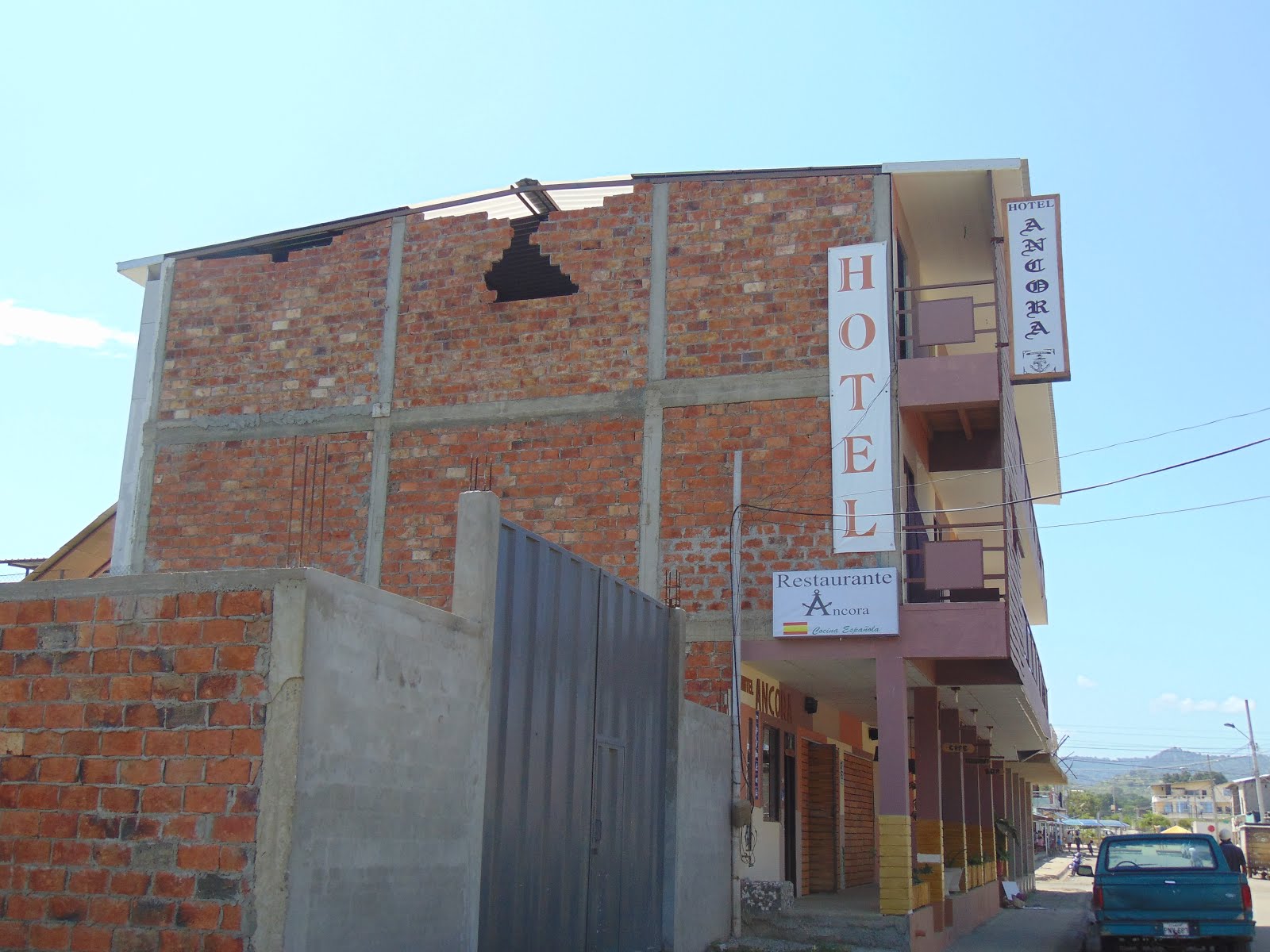
Several buildings lost upper stories like this.


Most buildings directly on the malecon, including the beach cabanas and the new bath houses that are being built, appeared to be left untouched.


This relatively new home sustained some damage on the upper terraces, at least.


Now that electricity and internet have been fully restored and I have been able to see the published accounts, we were very, very lucky. The epicenter was about 250 miles north of our village, and damage was extensive even further away than we are. Since I have compared this earthquake to the one when I was growing up in Kentucky, Bruce has checked the differences. The Kentucky quake was a 5.2, but we were basically on top of it, making it feel like a 7 (according to reports). This one was a 7.8, but we were about 250 miles (about 400 km) away. There is also over 30 years of time elapsed between the two. I still think my experience of the intensity of the shake was similar. The differences were primarily that this one was in the dark, and I knew what was happening this time.

We also recently just experienced some minor, latent damage, though there have been some aftershocks going on. A few minutes ago, we heard a single knock on the back door. When we opened it up, some of the concrete decorative facade has fallen off of the side of the rooftop terrace. We told the girls to be careful walking around the sides of the house for the next few days. We don't want any pieces falling off and hitting them in the head.


The girls have been clingy today and are very thankful for how lucky we all were last night. Even Blue is starting to settle back into normal, though he is still a little fluffy today. He's mostly thankful for the apple!


Monday, March 28, 2016

Shop added at http://www.cafepress.com/travelingeezers

We have added a shop where you can purchase products with our photographs on them. Check it out at http://www.cafepress.com/travelingeezers/13434930.

We'll be posting more from Puerto Lopez and other places around Ecuador soon. Sometime around September, we will begin our drive around South America.

See you soon!

Tuesday, December 1, 2015

Days 59-62: Through Colombia and Home in Puerto Lopez, Ecuador at last!

Driving from Cartagena, Colombia, to the border of Ecuador was relatively uneventful. Once we got off the Ruta Caribe (Carribean Road), we were reminded to fasten our seatbelts and not drink and drive.


I also loved they the Colombians let you know of points of interest nearby.


And, hitchhikers are always able to find a ride! This is a container on a car hauler with two guys on the back. This was not an uncommon combination!


In the northern part of the country, the landscape reminded me of the area in which I grew up, except the hills were bigger and steeper. In my part of Kentucky, the hillsides tended to be dotted with cattle, predominantly Holstein. Sometimes, those cattle dotted the road, too. (At least ours did!)

We were also driving up and down hills, seeing nothing other than farms and a few houses. Suddenly, there was a little town that may have a cross street, but not necessarily. These little towns all had the same makeup: A few houses, a restaurant or two, a gas station, and a little market. Every two or three towns, there would also be a farm supply or feed store.

The architecture was different, too. In Kentucky, the homes tended to be colonial-style farmhouses or ranch-style homes. In Colombia, the buildings are the tradition block and brick structures.


As we drove further south, Colombia began to look more like an Andean country than Appalachian. These mountains really can make a person feel small.


We made it almost to Medellin the first night. We stopped for gas. This station was definitely full service.  They had gas, rooms, and a restaurant. Pretty handy! They had serious chuckles at our shorts and T-shirts while they were bundled up in winter coats. It was pretty cold! So glad there was somewhere around 20 blankets on the bed!

The next day was a difficult drive. The mountain roads in Central and South Colombia aren’t wide enough to accommodate one-way traffic when you consider semi-trucks and hairpin curves. They are two-way roads, though. Often, trucks had to stop and wait for traffic on the other side to pass before they could enter curves, or oncoming traffic would have to stop and wait for the truck to complete the curve. Passing was treacherous but possible, trust me – Bruce was driving! 


There was a heavy military presence throughout Central and Southern Colombia, especially guarding bridges. They were all very nice and waved back at us and smiled. About half of them would give a thumbs up when traffic went by. They had huge smiles when we gave them the thumbs up back! I’m really not sure what it meant, but it was fun.


The award for best police officers is going to have to go to Colombia. We got pulled over for document checks a few times. I feel confident we were pulled over a few extra times because Florida doesn’t issue a front license plate, but that was only an issue one time. In Medellin, the officers that pulled us over seemed very frustrated that they pulled us over and couldn’t find anything to ticket us for. They circled the truck a few times, made several comments about the lack of a front plate, and examined all of our documents very closely. They finally let us go, though.

Other than that, the police were exceptionally friendly. Once they saw that we were driving a US vehicle on a temporary import permit, they wanted to just chat for a bit. One officer didn’t even take our documents to look at. He just noticed that I had them. “Where did you come from?” “The United States, but we entered Colombia in Cartagena.” “How do you like Colombia?” “It’s beautiful and so full of history!” “Do you like the food?” Bruce says “Yes” with me and pats his belly. The officer laughs and pats Bruce’s belly, too!! He wished us a good trip and sent us on our way, never having touched any of our documents that were sitting on the console during the exchange.

Another one noticed that when he would ask Bruce questions, I would answer, so he asked if Bruce spoke Spanish. “He only speaks a few words.” The officer: “Gracias, Buenos dias…” Bruce: “Cervesa.” Me: “More cervesa!” The officer: “He’s learned a lot! That’s all he really needs to know!” He briefly glanced at our documents and wished us a pleasant trip.
                                                                                                                                                                                   
The Colombia-Ecuador border crossing was one of the easiest, and definitely the cheapest! Processing out of Colombia was easy. We went to the Dian to cancel the TIP for the truck. We could have just gone right on past. No cancellation paperwork, stamps, or anything. Just turned in the original permit. I’m glad I had an extra copy! Then, get the exit stamp in our passports. That got us out of Colombia.


Entering Ecuador just required filling out the immigration form and getting our passports stamped. One of the aduana guards noticed that I was standing in line a long time to get the TIP for the truck, so he went to a different building, came back, and escorted me to that building, where we sat down in a comfortable office, and a guy took care of our permit. Unlike most other countries where you can get a 30-day permit that can be extended, he issued us the full 90 days to correspond with our T3 visa. We asked about SOAT insurance, and he told us it was no longer required, so to not worry about it. I had copies of everything, but he just took pictures of my documents and uploaded them into the computer and gave me back my copies. I’m not sure what’s going to happen when we try to extend it, but we’ll cross that bridge when we come to it. This was the first country we entered that did not charge for the permit, inspection, insurance, or any number of assorted fees to bring the truck (and often ourselves) into the country. I was so excited about how easy and free this crossing was, I forgot to take pictures of the processing center, but here’s the Welcome to Ecuador sign taken from outside the Colombian side.


We’re definitely back in Ecuador! The slower drivers are hugging the shoulder of the road so you can pass, and three wide over a speed bump is the norm, especially if you’re passing a truck or bus. The landscape is beautiful, and livestock is herded on the roads. We stopped for the night just past Quito. Initially, I had planned to see a few things in the northern part of the country on our way, but we’re ready to get home. We decided to just get to Puerto Lopez, and we’ll make a trip back up to see the things we missed later.


Loved seeing the palm trees on the side of the mountain along with the trees expected at certain altitudes, though I believe we had come down from official “altitude” by this point, I think we were still pretty far up.


There have been a lot of changes to Puerto Lopez since we’ve been gone. The next post will either talk about the changes in town or run down some of the expenses on our trip.