Sunday, April 16, 2023

Cranes, Trains, and Flying Automobiles!

Pulling out of Lincoln on I-80, it didn't take long to find the first kitschy thing to see - the largest covered wagon in the world.  It has been a few different businesses over time, including a gas station with a campground around it.  It also used to have wheels and windows and a caretaker.  Over time, it has fallen into disrepair.  Wonder how long it will remain.

We left the Gulf Coast little earlier than we had initially planned, which was a good thing.  Serendipitously, we caught the tail-end of the Sandhill Crane migration through Nebraska.  I have always loved the Sandhill Cranes, even when they serenaded me in the early mornings in Florida with their "dinosaur" sounds.  But I have never seen so many in one place!  I know I saw more cranes driving through Nebraska in one day than I saw in all the years we lived in Florida, cumulatively, even if you count every crane sighting as an individual bird (which I know they were not!)  Some were doing their little mating dance, and many were flying in.  Corn fields were full of them, along the interstate and the backroads.  Kearny, NE, says they get the highest concentration of them in the world, and that is the location of the Audubon Rowe Sanctuary, which I missed in my reading while planning this route.  I saw so many beautiful birds (not just Sandhill Cranes) through this stretch of the drive.  If we come through this route again, I'll definitely want to spend a day at some of the bird sanctuaries or reserves.   I spent years trying to get good pictures of birds in flight.  Thanks to having a group of birders and excellent guides on the Antarctic cruise, I now know how to do it.  Still practicing and need a longer reaching lens, but it's coming along!


We swung off the interstate in Grand Island to see Fred's Flying Circus.  Fred is no longer with us, but when he was alive, he liked to spend his free time restoring old cars into cartoon characters and raising them on tall poles so they were in the air and could be seen over the walls of his garage.  Upon his death, his family have kept the garage going, including maintaining his "flying circus".  It's really a neat stop.  We were there on a Sunday, when the garage was closed.  I don't think they do any tours when they're open.  From what I understand, everything there is to see is easily viewed from outside the walls.


This is the only one that was on the ground.  It was great they way the back end is sticking out and the painting on the wall just comes right off of it.

The town was fully decorated with the little blue pinwheels in recognition of April being Child Abuse Prevention Month.  The pinwheel signifies the good childhood every child deserves.  This has always been an issue close to my heart and one that I've spent many years working within.  It felt good to see a town mark it so visibly.  I only hope their policies and actions in the courts and administrative offices also reflect this.  Far too often, the courts and government agencies exacerbate the problem.  But, I'll get off my soapbox - for now.

Another unique thing about Nebraska is that they have a museum that is housed inside an arc over the interstate.  The museum is an old western history museum, and having grown up on spaghetti westerns that my dad watched ALL the time, I wasn't really into it.  They had a nice looking trail and some shadow bison.  It was too cold to hike, but I'll probably build time for that if we come through this way again.  Might even go into the museum.  It's a nice building and grounds, though.


The fire fighters museum on the way back onto the interstate had the fire dog "R. Hero" ouside.  He was adorable!

Back on the road, we finally made it to North Platte, where we just had to check out the trading post, where they have a "tourist trap" on bold display!


They had a little miniature museum of the wild west show


And the exhibit I always love - a "please touch" section with lots of pelts!  I was expecting the badger to be softer, but the skunk was cuddly soft!


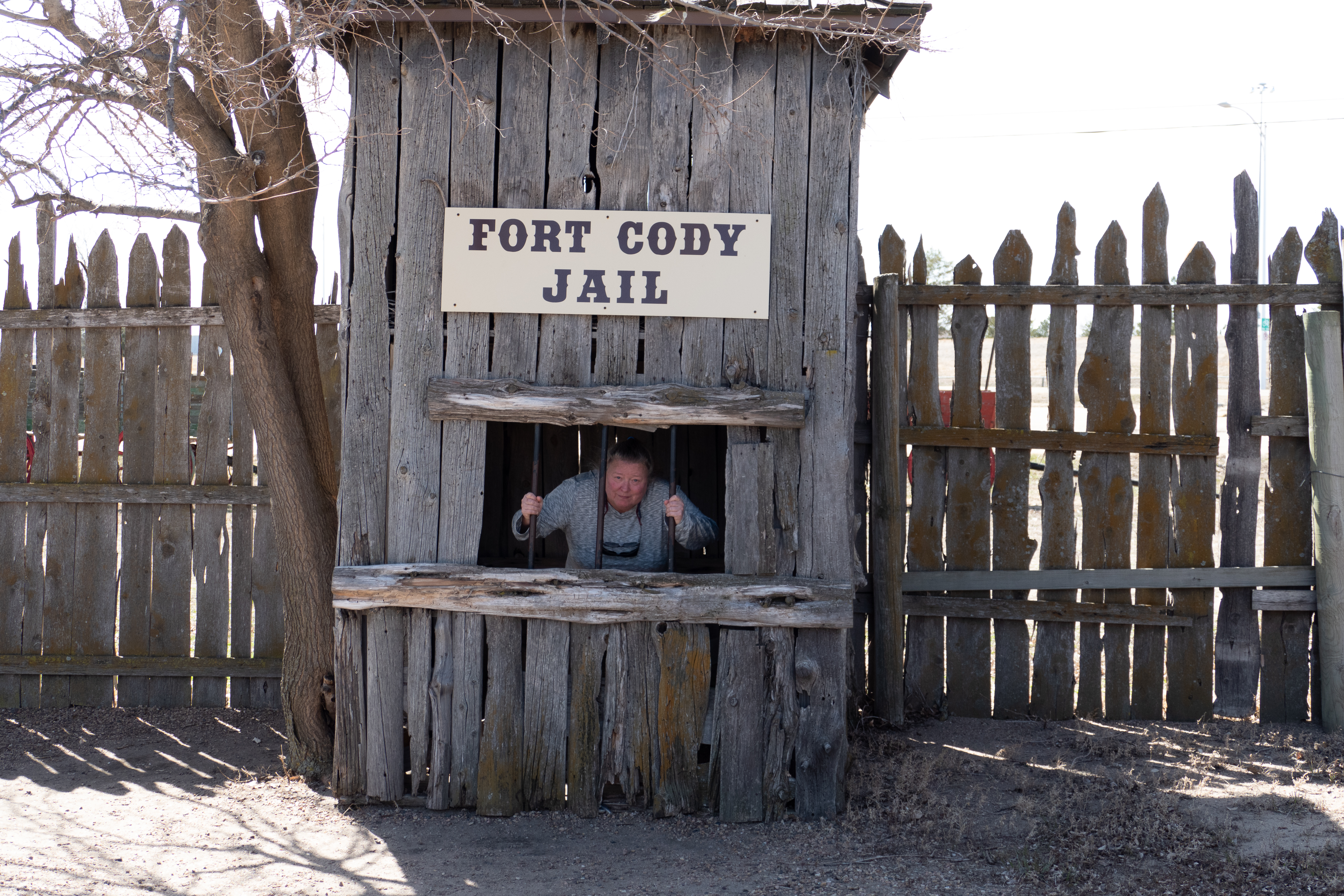
I don't remember what my offense was, but I'm sure it was pretty bad!  Thankfully, Bruce had bail money.  I usually like to gather new jams, jellies, syrups, or similar items in my travels.  This time, the bail money went on moonshine jelly and Gramma Mazie's Toe Jam (a blend of tangerine, orange, and elderberry).  I haven't tried it yet.  Waiting for my new blood sugar medications before I ingest that much processed sugar!  My numbers have been higher since I got back from Patagonia, so I'm trying to be better-ish.  


We finally made it to today's final destination - the Golden Spike Tower in North Platte.  The Golden Spike Tower sits as an overlook to Bailey Yard, the largest train yard in the world.  It covers 2850 acres and manages an average of 14,000 rail cars every 24 hours.  It has 17 receiving tracks and 16 departure tracks with two “humps”used for sorting the cars.  When a train comes in, it passes over either the east or west hump, depending on the direction it is traveling.  The hump is built up so that it is higher than the rest of the tracks.  On the hump, a worker scans the car to determine its final destination.  They then switch the tracks so that car (or cars if several in a row are going to the same destination) roll down off the hump, down the track, and onto the track designated for that final destination.  At a designated time, a locomotive will back up into a particular track and attach itself to the cars for that destination.  Most of the time, the locomotive will be going to either another sorting yard or multiple destinations, so once it picks up the rail cars for one destination, it may pull forward and back into another line of cars to attach those.  It can do this for multiple destinations.  I found this yard fascinating.  There is a movie to give a broad overview on the ground floor, and then you go to the 7th or 8th floor for viewing.  The 7th floor is open air, so there is no glass.  The 8th floor has docents that will explain what you are watching.  I strongly suggest spending some time with the docent.  Ours wanted to make sure we understood that a locomotive was not an engine.  Instead, the locomotive moves the train using electricity generated by the engine.  If you ask me, it's a distinction without much of a difference since the engine appears to be housed inside the locomotive, but he had a lot of other knowledge, and the day wouldn't likely have been nearly as pleasant without the information he imparted to us.

There is a little wooden train scultpure in the courtyard with an arc of flags of the 13 states that are serviced by this train yard.


It's a long way down from the 8th floor


The golden spike was not laid in North Platte, Nebraska.  The tracks came together in Promontory, Utah, where the Golden Spike National Historic Park is.  This was named the Golden Spike Tower, however, because it was architecturally supposed to resemble the golden spikes that were used to unite the eastern and western sections of the tracks.  The word "resemble" is used in its loosest terms.  But one of the golden spikes from that uniting is housed in the tower on the 8th floor.


In this video, you can see the cars separating and going different ways from the hump


In this video, you can see the tanker reaching the line of other cars going to its particular destination with enough force to couple with the cars already waiting.


It was still early in the day when we finished the Golden Spike Tower, and our next planned stop was on the other side of Wyoming - the United Pacific round house in Evanston, Wyoming.  So we drove on down the road, stopping for the night in Cheyenne, Wyoming.


Tuesday, April 4, 2023

A Cave for Robbers (and children and others) in Lincoln, Nebraska

It's that time again.  Time to head back to the Pacific NorthWest.  We're leaving a little earlier this year because Bruce made an early doctor's appointment.  That's okay.  I need to get up there and get started on my appointments to try to prepare for my next big adventure. My doctor had some tests run at the Gulf Coast VA based on symptoms I experienced in Antarctica and Patagonia, and now I need to visit the specialists that can help me with them.  So, after sliding in to see family in the area one last time for the season, we headed west.  This time, we decided to take a different route.  We crossed into the Ohio River Valley around Owensboro.  Soon after crossing the Ohio River, which I have traveled many times in my younger days, I learned it had been designated as a Scenic Byway.  I always thought it was beautiful growing up in the area around Maysville, KY/Aberdeen, OH, and traveling the roads along the Ohio River to go to Cincinnati, Evansville, and other points in the area.  It took me by surprise to find that what I had always thought was an ordinary beauty has actually been designated as an extraordinary beauty.  The Ohio River Scenic Byway is apparently a National Scenic Byway and follows the river across the states of Ohio, Indiana, and Illinois.  We only got to see the tail end of it this time, but it was still as lovely as ever.


The old lock and dam building in Newburgh, IN


We got detoured off the interstate system because of a horrendous crash just outside of St. Louis and ended up spending the night in a little town called Macon City, Missouri.  The interesting thing about this town is that it appears to have been settled for no reason other than to have a place for the farmers to come in to eat at a restaurant.  A tiny little town with about 10 restaurants!  We chose a little diner and were quite satisfied.  For some reason, I didn't take a single picture here.

Our first scheduled stop was Lincoln, Nebraska.  We got there nice and early so went straight to Pioneer Park.  Pioneer Park has a small Nature Center with a herd of bison in a pen.  The nature center was closed, but the bison were close enough to see well.  They had some shadow bison with information about them, too.  I loved the carving on the welcome sign!


Driving through the park, we also saw a statue of a Native American called "Smoke Signals".  This statue was approved by the local tribes before it was erected and blessed by them during the unveiling.  It is supposed to show that unity was hard achieved between the white man and the Native Americans, but that it has, in fact, been achieved.  The brave has his back to town, and the signals he is making are supposed to be as a warning that the white man is coming.  Someone has broken off the feather in the brave's hair.


After driving around the park, we finally found what we were searching for - the columns from the US Treasury Building in DC!  According to the plaque, the columns stand at the park entrance, but they are, in fact, back along some of the hiking trails and a bit difficult to see from the road unless you are specifically searching for them.  They are made of sandstone and were quarried in Virginia before being used in the US Treasury Building when it was erected by President Jackson.  When President Lincoln reviewed the troops during the Civil War, he apparently stood in front of the Treasury Building between these columns.  Because of that, when the Treasury Building was remodeled, and these columns were removed, a dude decided to buy them and give them to the City of Lincoln, Nebraska.  The city now kind of hides them in this park.  Two of the four have broken over the years.  They're kind of neat.  I'm looking forward to getting to the doctor, though.  I was terribly out of breath just from climbing the little hill from the road to the columns and back.  I've continued to walk and keep my exercises up, but hills just kill me, and they don't have to be steep hills!  I need to be able to trek uphill to see those mountain gorillas in the fall!


After the park, we got checked into our hotel because the next attraction was underground, and Bruce doesn't do underground.  The front desk of our hotel suggested a little diner that was in a gas station.  So we headed there for late lunch/early dinner.  The food was delicious and the decor was very old-timey with old time vehicles, gas pumps, fire engine, ice cream vendor, and more.  We had plenty of food to take back to the room for actual dinner.  We went back for breakfast, which wasn't bad, but did not live up to our expectations after dinner the night before!


After eating, I dropped Bruce and the leftovers at the hotel and headed out to Robber's Cave.  This cave has a sordid and active history.  At different times, it has functioned as a daycare, a speakeasy, a hangout for Jesse James and other bandits, a shooting range, and many other things, including just a place where kids hung out, carved things on the wall, and generally trashed the place.  It is a sandstone cave, so not a cave with the stalagtites, stalagmites, and other limestone or other mineral cave formations.  In fact, if you scrap away the darker top layers of sand, you have light sand.  It's close to white sand, but doesn't get sunlight for bleaching.  The guide is really good.  He has studied the cave's history and written a book about it.  A group from Knoxville has shot a documentary about it which should be coming out on Netflix before long.  I'm looking forward to seeing it.  If you ever find yourself in Lincoln, Nebraska, you should check out the Robber's Cave.  This was one of the activities that made me glad I chose the route this year to go through Nebraska.


This is the first room downstairs.  The curved door is the entrance to the cave area.


One of many shots of the carvings.  The guide made comparisons between social media and cave drawings, past and present.  Cave etchings or vandalism?  You decide!


Scraping away the top layer of sand


A mineral seam runs through the cave, but you can see the various hues along the walls.


This was an area where picnic tables used to sit.  The green and red are from the netting, not the cave.  There is an opening in this area, and bats like to nest her.  The netting is to keep the bats from bothering people or people bothering bats.


I had to have some help getting through a few areas.  Some of these steps had really high rises!


There used to be a fire pole here.  Too many people got hurt sliding down it and onto the previous person!


You can see the marks where the cave was extended by hand using a pickaxe.


According to those who would know, that lower shelf is the perfect height for a drummer in a band with a trap set!


I was surprised at all of the things to do in Nebraska.  It's not a South Dakota (which I'm still trying to see more things in!), but don't write it off like I have done for so many years!


Sunday, March 5, 2023

Banding Little Birds

 I love being a part of multiple Facebook groups.  That's the easiest way to learn about things to do in any area.  Recently, the Mississippi Coast Audubon Society put out a call for people to help with banding of a local population of Henslow's Sparrows.  The Henslow's Sparrow is considered near threatened, and a population is believed to be recovering in the Mississippi Sandhill Crane National Wildlife Rescue in Gautier, Mississippi.  Anybody who knows me would not be surprised to learn that I jumped at this opportunity!

So, up nice and early on a Saturday morning.  Sprayed up with bug spray and sunscreen with my hiking boots.  Ready to traipse through the boggy, uneven, wet pine savanna of coastal Mississippi.  With camera in tow, I headed to the visitors center.  There was a pretty good crowd assembled.  I didn't count, but there were enough of us for two groups to flush out the birds.  Our leaders for this activity were Dr. Abby Darrah with Audubon Delta, a regional section of the National Audubon Society, and Dr. Mark Woodrey with Mississippi State University.

After a brief description of the bird that was our target and some other birds that could be mistaken for the Henslow's Sparrow and a brief summary of what we would be doing, we carpooled to a part of the park that is not open to the public.  Once there, two nets were prepared and we split into two roughly equal groups and headed into the savanna.  We walked in lines through the savanna toward the tree line, watching for birds to fly up.  Once you see one fly up (flush out), you keep an eye on where it landed, which is usually just a few feet up from where it flushed out.  In my group, Mark and Abby then walked around in the direction the bird flew, posted the net behind it and opened the net to prepare to catch the bird.  Once the net was positioned, the rest of us formed a semicircle around the bird with the net closing the arc.  Then we walked toward the net, causing the bird to fly again, into the net, where it lighty tangled into the net, long enough for Abby to retrieve it and put it into a small cloth bag.


Once the bird was in the bag, Abby's banding kit was produced by the photographer that was carrying it. This tackle box contained all the tools needed to check and record the bird's vital information and band it for future study.


Abby held the bird for a while in what is known as the photographer's hold.  Only skilled ornithologists should ever hold a bird this way because an inexperienced person can cause a dislocation of the joints of the feet and legs.  People skilled with working with the birds can hold onto them without causing harm, even if they make a half-hearted attempt to fly away.


Once the camp chair and Abby's kit were settled, Abby got to work on the vitals check.  Mark scribed the information on the appropriate form.  She took a pair of special pliers and closed the tiny band on the bird's leg.  These bands are absolutely tiny, and if I remember correctly, she had smaller bands in the kit!

Then, she measured the wing, also checking it for mites and other parasites and for signs of age markers.  For the purposes of this activity, the birds were aged as either "hatch year" or "after hatch year".  A piece of interesting trivia is that birds, like horses, all have a birthday on January 1 of each year.  So, even for the young bird who was believed to have been hatched this past fall, it is now a one-year-old, and aged as AHY (after hatch year).


After this, Abby move the bird close to her face and blew into its chest.  There is a spot on the chest that is almost transparent below the feathers.  Through this window, you can see how much fat the bird has.  While birds do not hold much fat, as they must be light enough to fly, some fat is required to be able to migrate, especially when that migration occurs over water or other areas where they are not likely to find food.  They will have different levels of fat depending on the season and their life cycles.


Finally, she pulled out the scale and a piece of PVCpipe.  She placed the pipe on the scale and zeroed it out for tare weight.  She lowered the bird into the pipe head first and hovered her hand just over the pipe to prevent any escape, weighing the bird in grams.

Once the weight was recorded, she placed the bag over the pipe, and the bird flew back into the bag.


At this point, if there was anything that needed to be double checked, that could be done.  Or the bird could be released or any further study done.  In our case, the bird was passed off to a volunteer who could hold the bird in the protective hold and release it.  The protective hold is to cradle the head and neck gently between the first and middle fingers in one hand while letting the bird's feet stand on the other hand.  Fortunately, when it was my turn to release the bird, the Audubon photographer, Gary Herritz agreed to send me copies of the photos!


It was such an amazing experience and a highly memorable morning!  I will definitely participate in more of these activities as I learn of them, and I would recommend it to anyone!  Just locate the Audubon Society in your area and ask about activities they sponsor with public participation!