Sunday, March 5, 2023

Banding Little Birds

 I love being a part of multiple Facebook groups.  That's the easiest way to learn about things to do in any area.  Recently, the Mississippi Coast Audubon Society put out a call for people to help with banding of a local population of Henslow's Sparrows.  The Henslow's Sparrow is considered near threatened, and a population is believed to be recovering in the Mississippi Sandhill Crane National Wildlife Rescue in Gautier, Mississippi.  Anybody who knows me would not be surprised to learn that I jumped at this opportunity!

So, up nice and early on a Saturday morning.  Sprayed up with bug spray and sunscreen with my hiking boots.  Ready to traipse through the boggy, uneven, wet pine savanna of coastal Mississippi.  With camera in tow, I headed to the visitors center.  There was a pretty good crowd assembled.  I didn't count, but there were enough of us for two groups to flush out the birds.  Our leaders for this activity were Dr. Abby Darrah with Audubon Delta, a regional section of the National Audubon Society, and Dr. Mark Woodrey with Mississippi State University.

After a brief description of the bird that was our target and some other birds that could be mistaken for the Henslow's Sparrow and a brief summary of what we would be doing, we carpooled to a part of the park that is not open to the public.  Once there, two nets were prepared and we split into two roughly equal groups and headed into the savanna.  We walked in lines through the savanna toward the tree line, watching for birds to fly up.  Once you see one fly up (flush out), you keep an eye on where it landed, which is usually just a few feet up from where it flushed out.  In my group, Mark and Abby then walked around in the direction the bird flew, posted the net behind it and opened the net to prepare to catch the bird.  Once the net was positioned, the rest of us formed a semicircle around the bird with the net closing the arc.  Then we walked toward the net, causing the bird to fly again, into the net, where it lighty tangled into the net, long enough for Abby to retrieve it and put it into a small cloth bag.


Once the bird was in the bag, Abby's banding kit was produced by the photographer that was carrying it. This tackle box contained all the tools needed to check and record the bird's vital information and band it for future study.


Abby held the bird for a while in what is known as the photographer's hold.  Only skilled ornithologists should ever hold a bird this way because an inexperienced person can cause a dislocation of the joints of the feet and legs.  People skilled with working with the birds can hold onto them without causing harm, even if they make a half-hearted attempt to fly away.


Once the camp chair and Abby's kit were settled, Abby got to work on the vitals check.  Mark scribed the information on the appropriate form.  She took a pair of special pliers and closed the tiny band on the bird's leg.  These bands are absolutely tiny, and if I remember correctly, she had smaller bands in the kit!

Then, she measured the wing, also checking it for mites and other parasites and for signs of age markers.  For the purposes of this activity, the birds were aged as either "hatch year" or "after hatch year".  A piece of interesting trivia is that birds, like horses, all have a birthday on January 1 of each year.  So, even for the young bird who was believed to have been hatched this past fall, it is now a one-year-old, and aged as AHY (after hatch year).


After this, Abby move the bird close to her face and blew into its chest.  There is a spot on the chest that is almost transparent below the feathers.  Through this window, you can see how much fat the bird has.  While birds do not hold much fat, as they must be light enough to fly, some fat is required to be able to migrate, especially when that migration occurs over water or other areas where they are not likely to find food.  They will have different levels of fat depending on the season and their life cycles.


Finally, she pulled out the scale and a piece of PVCpipe.  She placed the pipe on the scale and zeroed it out for tare weight.  She lowered the bird into the pipe head first and hovered her hand just over the pipe to prevent any escape, weighing the bird in grams.

Once the weight was recorded, she placed the bag over the pipe, and the bird flew back into the bag.


At this point, if there was anything that needed to be double checked, that could be done.  Or the bird could be released or any further study done.  In our case, the bird was passed off to a volunteer who could hold the bird in the protective hold and release it.  The protective hold is to cradle the head and neck gently between the first and middle fingers in one hand while letting the bird's feet stand on the other hand.  Fortunately, when it was my turn to release the bird, the Audubon photographer, Gary Herritz agreed to send me copies of the photos!


It was such an amazing experience and a highly memorable morning!  I will definitely participate in more of these activities as I learn of them, and I would recommend it to anyone!  Just locate the Audubon Society in your area and ask about activities they sponsor with public participation!

Monday, February 27, 2023

Drive-Through Petting Zoo and More!

So, after getting some rest, I became restless.  Bruce saw an ad for a buffet restaurant that looked awesome, but it was all the way up by Tupelo, MS.  Given, that's not really bad when you're on the Mississippi coast, but who wants to drive five hours each way and get a hotel room just to eat supper? I mean, we've done three hours each way for lunch, but who's counting!?  So, I checked to see what else there was.  Turns out, there's a drive-through petting zoo.  Because Big Red is in the shop (from being T-boned in a parking lot), and we have a rental car, it seemed like an ideal time to do a drive through where bufallo and other wild-ish animals come to the window and brush up against the car!  (We're still using touch-up paint from driving through the Olympic Game Park drive-through petting zoo in Sequim, Washington!)  So, off we went!  It was a great idea!

We set out on Saturday morning before the parades started getting started for the final week of Mardi Gras.  Bruce set navigation on interstates instead of back roads, and after a couple of hours, I realized we were going through Meridian.  I had seen a little blurb about there being a nice waterfall just outside of Meridian, and lo and behold, there was a sign for that waterfall just as we were leaving that town.  We decided to maybe stop by on the way home.  

This trip was very loosely planned (other than booking a hotel room the night before we left), but we still pulled into Tupelo early enough to see the wildlife park.  It being rather cool, we figured we didn't have to worry about the animals being so hot they weren't moving around.  So we pulled up into the Tupelo Buffalo Park and Zoo in the early afternoon, plenty of time to do both the drive-through and walk-through portions.  The lady said they were discounting tickets that day because it was too cold for some of the animals to be out.  The kangaroos, primates, and some others that can't deal with the cold were inside where they could have heating.  (Good reason to come back!)  We bought three buckets of pellet feed (two for the drive-through and one for the walk-through) and set out.  There are signs when entering to not pet the animls and to keep sunroofs closed.  They also tell you in the store and on the sign that if you lose your bucket, do not get out to get it.  Just leave it on the ground.  I'll follow most of those rules!  The first animals in the drive-through are the zebras.


Surprisingly, these guys were very nice and took turns.  There was no pushing and shoving.  Not knowing how many different animals and how long the drive-through was, I probably short-changed these guys on their kibble.  And when I started to roll the window up, they just stepped back.  Quite pleasant!

After crossing the cattle gate from the zebra enclosure, we found ourselves in the buffalo area.  These guys were excited to see us!  It was a little intimidating to begin with!


Pardon the glare through the windshield!  After the stampede (lol) got to us and they surrounded the car, they were quite settled and just looking in the windows expectantly.  Once they spread out a little bit, I rolled the window down and started feeding.  Their facial fur is much softer than it appears!


These guys didn't even try to put their heads in the window, but when feeding the taller ones, I rested the bucket on the door, so they were closer to being in my lap.  This guy was little more than a baby, though.  When closing the window, they pulled their heads back a little bit, but they stayed close enough that they wiped their noses on the windows!  The picture's a little distorted from the window glare and buffalo boogars and snot!


There were some other large animals in this area, but they were behind fences and difficult to get pictures of.  Just FYI, these animals all looked well cared for and well fed.  Being winter with most grasses dormant, there was plenty of hay in the fields, and one of the owners was putting out more hay while we were there.

Passing over the next cattle gate, we encountered the tall group.  The giraffes were inside in the warmth, but the camels looked in through the sun roof!


Again with nice, soft and shiny coats, these guys looked and felt to be well cared for.  What was that?  There's no petting the animals in the drive-through?  Who said?


This emu didn't want to take his turn, and he and the camel both lost out when the emu bit Bruce's finger while he was feeding the camel!  Bruce cursed and brought the food back into the car!  It didn't draw any blood - we checked - but Bruce said it hurt like hell!


After getting bitten, we drove on to the next section, which was miniature horses - too short to reach the windows, so I just scattered some for them.  Llamas and alpacas were in this section, too.  The yaks were in a close enclosure, and this guy raised his head for a nice shot.


I still had half a bucket when we got back to the entrance, picked up the walk-through bucket, and headed for the petting part of the zoo.  This was where I made really good friends with llamas at the tail end of the drive-through portion - and where I was a really bad role model for the kids that were visiting.  Because I only have two hands, I used the bucket when I wanted to love on the animals, but I mostly hand fed and just carried the bucket around.  There was a family walking around with three kids.  The little girls didn't have anything to feed the animals and were eyeballing my bucket (but not begging or anything - you could just tell they wished they had one), so I ended up giving them the full one - and encouraging them to feed the animals from their hands (because I'm really a bad role model!).  This expectedly caused excited shrieks when they got animal slobbers on their hands!  "Ew, gross!  Give me more feed so I can do it again!"  Made my heart smile!


We exited through the bird barn where there were lots of birds and a sign asking that you not curse in the barn.  Don't want the macaws and cockatoos picking up the wrong language!  I spent some time trying to get a good picture of the African crowned crane - a favorite bird of mine that I hope to see in its natural habitat this fall!  He was really fast, but I think I got a good head shot!


Back inside the gift shop, where the  coatis and sloths were hanging out, Mama Sloth decided to show me what she had been holding on her stomach.   She leaned over, and Baby Sloth peeked over her neck at me!


All in all, it was a good place.  We talked with the owners some, and they really seem to care about the animals.  Couldn't believe the Sequim place has people feeding bread to the animals instead of something good for them.

When we left the zoo, we checked into our hotel, cleaned up and rested a bit, and headed out to Butler's Fish and Steak in New Albany (about 15 minutes away), the buffet Bruce wanted to try.  We got there about 5:00, and there was already a 40 minute wait!  I was too busy eating to take any pictures, but it was a good very good dinner with all kinds of seafood (from frog legs to oysters on the half shell and everything in between), average steaks, and good vegetables.  Desert was a little lacking with banana pudding being the only thing I saw.  Overall, we'll come back if we're in the area at supper time on the weekend!

After a good night's sleep, we headed back to Biloxi.  Since we were going through Meridian anyway, we decided to stop at Dunn's Falls, the largest waterfall in Mississippi.  This fall was created in the 1850s by Irish immigrant John Dunn, when he redirected the Chunky River and placed a wheel on the falls to power  his mill.  The park is on the side of the road, and the falls are just steps from the park entrance.  It's a pretty fall, but it obviously doesn't compare to the last waterfall I went to see (Iguazu Falls in Brazil and Argentina).  I mean, I could get the whole falls into one picture, and it didn't even have to be a panorama!  While I was tired after climbing the steps to the top of the 65 foot falls, it wasn't anything compared to how exhausted I was climbing those steps after doing the power boat under the Iguazu Falls in Argentina!


The grist mill had been rebuilt and was actually a different mill that was moved from Cave Springs, Georgia.  There were warning signs based on the lack of stability of the structure - 


but a closer look was required!


It was a great weekend, and we did vacuum the pellets out of the car, but those pellets are going to be coming out of that car door every time the window goes up and down for a while!

After we had been home a couple of days, we heard that a boat that had been docked in one of the marinas was leaving soon.  I thought they were talking about the replica Pinta (Christopher Columbus's ship), and I wanted to go see it before it left. So, we headed out to the Schooner Pier.  The sign said the boat would be there until April and that they were open for self-guided tours on the weekends.  This was a Thursday, but I walked down the pier anyway to get pictures of the outside even if I couldn't get on.  It is a TINY ship.  All sailors lived and slept on the deck.  The hold simply held supplies.


The sails were pretty impressive, though, and probably would have been even more impressive if they could have been unfurled.


While talking with one of the two guys that travels with this ship, he mentioned that there was a larger sloop at the Cadet Point Marina that travels with school kids.  He said that ship  was leaving soon and suggested we go see it before it pulled out.

That schooner didn't allow tours, but it has crew from two different high schools in the northest (Met High School and Proctor Academy), and the kids get semester credit for science, literature, math, history, and seamanship skills as they work alongside the crew in navigating this vessel along the Atlantic Ocean and the Gulf of Mexico.  While we weren't able to board the schooner, we did get to talk to some of the kids who were out and about getting ready for sailing.


Adventures don't have to be far from yor front door!


Friday, December 9, 2022

Hard to Reach Treasures - The Marble Caves

After hiking the Perito Moreno glacier, my plan was to visit the Marble Caves in Puerto Rio Tranquilo, Chile.  So, I got all my things packed up again and caught a bus to Los Antiguos, Argentina, on the Argentina/Chile border.  I would have liked to have spend an additional day in El Calafate, just practicing my balance exercises after getting disoriented, but the bus from Chile Chico to Puerto Rio Tranquilo only runs once a week, and it was going to be tight making it on time.  The bus to Los Antiguos pulled into the station just a few minutes late.  No problem.  We made it about a kilometer down the road before we had to turn back because of engine problems.  After a bus change, we were back on the road about an hour later.  Not a good sign.

The plan in Los Antiguos was to catch a taxi from the bus station to the border.  There was no taxi stand at the bus station.  The few people who were still on the bus when we arrived in Los Antiguos, just took off walking to their destinations.  Luckily, there were some people in the bus station cleaning.  One of them called me a taxi.  The border was very close to the bus station, only a 400 peso trip to the border.  The taxi driver did give me some disturbing news, however.  There is no transportation from the Argentina border to the Chilean border.  No taxis are allowed to provide service between the two borders.  No busses provide service between the two borders.  There are no car rentals in Los Antiguos, let alone anythat will allow you to drive across the border.  He told me that most people "hacer dedo", or ride their thumb.  The others walk.  He estimated it to be 10 km between the borders.  Well, that was my options.  I was not thrilled with them, but I wasn't going to make it to that once-a-week bus to Puerto Rio Tranquilo by standing around sulking, so off I went.  When I cleared immigration out of Argentina, the agent confirmed that the only two ways to get to Chile were to walk or hitchhike, but said the distance was more like 5 km to the Chilean border and that some people appear to be able to get a taxi from the Chilean border on into the town of Chile Chico.  In hindsight, Google Maps says it is 2.7 km or 1.7 miles between the borders.  There was a couple sitting outside the immigration office who were just going to try to hitchhike from there.  I thought about that, but then decided I should probably start walking and try to get a ride as I went.  I had no idea how long it would take for somebody to come along this border crossing, which was not a busy crossing at all, and I needed to be in the  Chile Chico bus station by 1:00 or wait a week to get to the marble caves.  So, off I went.

I walked about half a mile before a car pulled over.  It was a family of 4, husband, wife, and two sons.  They put my bags in the rear hatch, and I got in the back seat with the boys.  We wondered a bit why none of the cooperativas showed any interest in taking this route, thinking it could probably make for some good income for short distances.  When we got to the border, they helped me clear immigration and customs and offered to take me on into town to the bus station.  I offered to pay them.  I had Argentinian pesos and dollars.  They wouldn't take anything.  They go back and forth frequently because they have relatives in Los Antiguos, and they always pick up hitchhikers because they think it's awful that there is no possibility of transportation for hire.

Chile Chico is a beautiful little town.  Thanks to that family, I made it to the bus station with time to spare for the bus to Puerto Rio Tranquilo.  The lady at the bus company stored my luggage for free and directed me to the nearest bank so I could get cash in Chilean pesos, since the bus was cash only.  This bus is a weekly shuttle for locals who come into town to work during the week.  It runs the opposite way on Monday morning.  The locals board from the bus station, and if there is room after that, the bus will pick up tourists on the corner by the square.  While waiting for the bus, a protest went through town.  They were protesting the city's decision to not allow a ferry service to open or remain open to shuttle tourists across the lake.  Apparently, the city interferes with the ability of its citizens to gather tourist dollars.  There's a lot of tourist money left sitting on the table because the city won't let the car ferry run, transportation between the borders, or more frequent transport in or out of town!

Los Antiguos, Chile Chico, Puerto Rio Tranquilo, and other small towns in both Argentina and Chile sit on the banks of the largest lake in Chile and one of the larger fresh-water lakes in South America.  The part of the lake that sits in Argentina is called Lago Buenos Aires.  In Chile, it is called Lago General Carrera.  It is a glacial lake that empties into the Pacific Ocean after running through several rivers and lakes.  The views on the southern shores of Lago General Carrera going west from Chile Chico are absolutely breath taking!  The cliffs against the shores of the water are every bit as beautiful and dramatic as those on the Pacific Coast Highway in California.  Then add in the backdrop of the glaciated and snow-capped peaks of the Andes mountains in Patagonia on the northern shore, and the views are even better than those of the PCH!  Unfortunately, we were packed, 18 people plus luggage, into a 15-passenger van navigating a gravel road often at the edges of those cliffs, so there was no attempt at getting pictures of those extravagant views!  I was just fortunate that I had a seat and was not one of the people standing.  As we headed south along the lake, people started getting off the bus, but by the time there was enough space to consider taking out my camera, the views weren't so extraordinary.  Don't get me wrong.  It was still lovely, but not "fighting over focus through the dirty windows of the moving bus" lovely.

We finally got to Puerto Rio Tranquilo about 30 minutes before the front desk of my hotel was scheduled to close.  So, I hop off the bus, gather my bags, pay the driver, and head to my hotel.  About half way there, I realize I left my parka on the bus!  This is the parka I got from the Antarctic cuise!  By the time I got turned around to where I could see where the bus had parked, it was gone.  So, with tears in my eyes (literally), I turned back and went to my hotel.  I got checked in and scheduled for the marble cave tour the following morning.  I mentioned that I had forgotten my parka on the bus, so should I go buy a new coat before doing the tour, and the lady assured me that it would be fine and that the tour operator would have ponchos for everybody.  And besides, she would give the bus company a call and see if she could get my parka returned. What?!  She knew the manager of the bus company?!  I might get my parka after all!  And in the meantime, she had a coat I could borrow for any rainy weather!  A ray of hope, but I was still bummed.  The restaurant was already closed and I was tired, so I just went upstairs to take a shower and go to bed.  

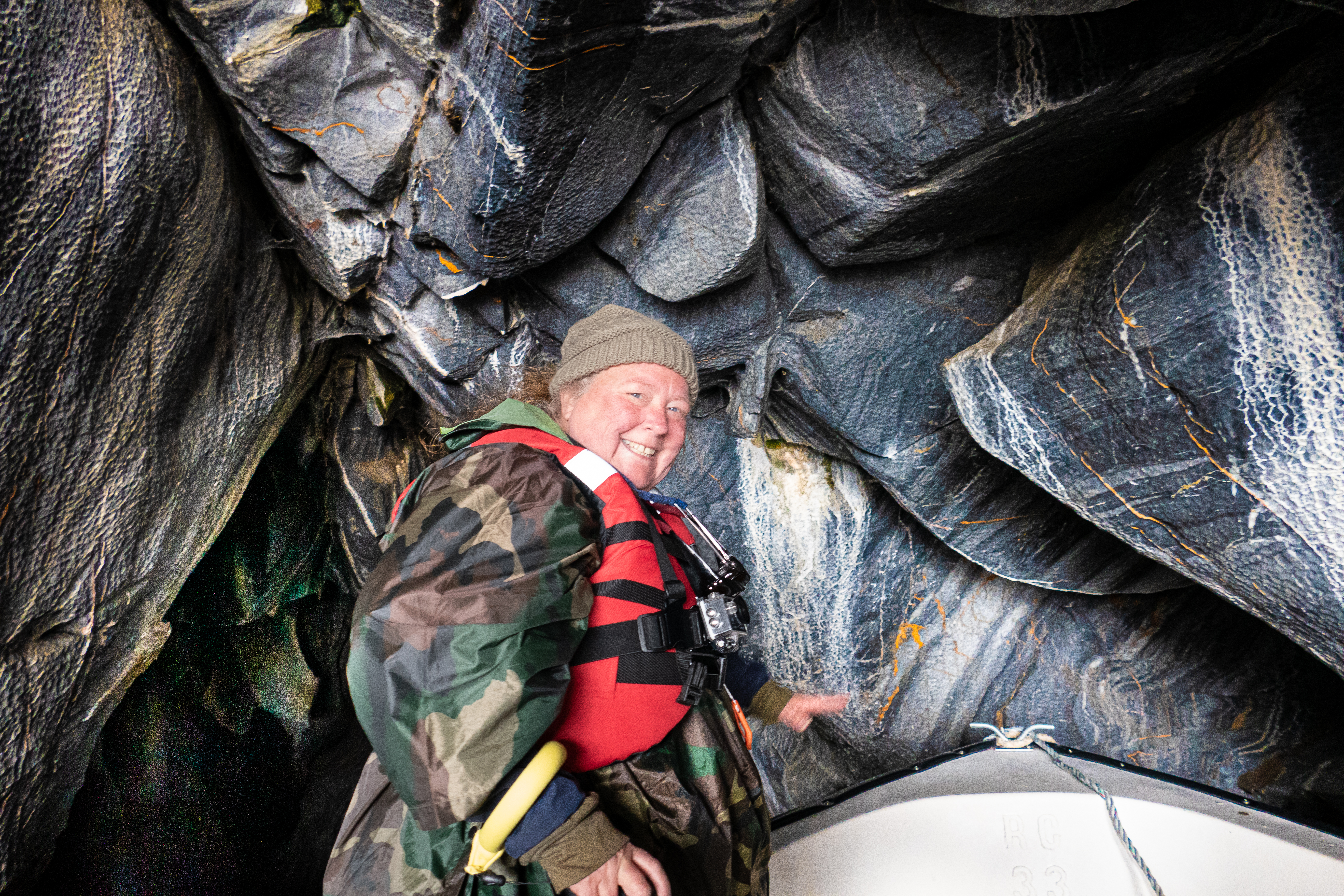
I got up the next morning for the marble cave tour.  The choice was to do the "full marmol" (full marble) or just the Marble Cathedral.  Of course, since I'm only going to do this once, I chose the full marble!  A large group of men from Chile, Argentina, and Italy also chose to do the full marble on this day, and they were also staying in the same hotel.  So, when the lady from the tour company arrived, all 14 of us headed to the waterfront.  I paid by credit card and was given a military-grade poncho and a life jacket.  Several of the guys needed help getting their ponchos on correctly so they didn't bunch up under the life vest.  I've worn these before, so no problem.  Then we walked over to the dock to board the boat.  Still having some balance problems, I needed some extra help getting on.  Since I was the only English speaker, I was close to the back of the boat since the captain/driver was the English speaking guide.  While driving out at speeds that splashed, I used the Fuji waterproof camera.  When we throttled back to slower speeds and we were allowed to stand and walk around, I pulled the good camera out of the waterproof bag.
We started at a shipwreck.


These boats were used for mining the minerals that are so abundant in the lake.  Mining is no longer done, as the government prefers to maintain the geological features of the lake, and much of it (such as the Marble Cathedral and surrounding area) are now national parks and protected areas.  After passing these shipwrecks, we began gliding along the coast, watching the caves unfold before us.  I had thought it was just the color that caused these caves that had been excavated by the waves over hundreds of years to be called "marble".  Turns out, the cliffs and coastline are made of marble!  These are caverns that have been washed away from huge mountains of marble.  You can see the veins of quartz and the colorization of the many different minerals that were fused into these mountains as they were formed under the pressure exerted over the eons.  And the water is just so crystal clear, too!    It was absolutely amazing!


Often, the guides would move the guys out of the way to make sure I got pictures of me, too.  The non-English-speaking guide had a really good time playing with my good camera.  He tried to get me posing, but I just couldn't do it on the boat with my balance messed up!


These birds, members of the duck family, nest in the caves.


The captain sent the guys to the back of the boat and let me ride on the solid deck (where there are no seats) while going into this cave!


As we got into the national park area, there were some natural formations that looked like animals.  This one is a fish.


A turtle and sea lion


A puppy dog


An elephant


He did some excellent driving to get us into some of these caves!


This Andean condor flew around at the top of the cliffs.  They like to nest in very high places.


This is the Marble Cathedral.


After seeing the caves and the cathedral, everybody took their seats and the good camera went back in the wet bag.  That's when the captain decided to "play cowboy"!  It was lots of fun.  He was intentionally hitting the waves in such a manner as to splash us and make it an "adventure" ride.  If you listen carefully, you can even hear one of the guys yell, "Yee-Haw!"


This is the town of Puerto Rio Tranquilo. They are very proud of their large population of around 600 people!


It was an amazing tour.  I'm so very glad I decided to come on up and see the  marble caves.  I had no idea getting here was going to be so difficult, though, and I decided that had to be it.  I was exhausted.  I didn't see any way that I could possibly enjoy the planned bus/ferry rides for three days to get to Santiago, and I didn't have the energy reserves for trying to put Easter Island together.  I decided I needed to go home and work with my balance exercises from physical therapy, spend some time without any mental load related to arranging transportation or lodging or even food and drinks, and get ready to work with my doctors on those things we didn't get taken care of last summer, like my tremor, and some new symptoms that I've started having since being in South America.

Booking a flight home was also a little difficult, as for some reason, it wouldn't book online.  The flights I wanted were on Latam/Delta.  They said I needed to call, but didn't give a WhatsApp number, and I just couldn't justify spending all that money for a phone call.  Thankfully, I have a wonderful daughter who made the call for me, booking my flights, and having Delta send me the itinerary and information.  Thank you so much, Chrissy!!  After booking the flight, I went downstairs to see about getting a bus to Balmaceda the day before flying out.  Turns out, there are no hotels or hostels or any place for indoor accomodations in the city that has the only regional airport in the area!  Thankfully, my flight was in the afternoon, and there is a daily bus from Puerto Rio Tranquilo to Balmaceda that leaves at 7:00 a.m.  Janet called the bus company and made sure I had a reserved seat on that bus and extended my hotel stay by a night.  The bus is cash only.  I was able to get cash by paying the merchant charge that Visa would charge them, and they rang me up as a purchase (not a cash advance) for enough cash to pay the bus fare.

I took a day just laying in my room, watching shows I had downloaded on Netflix.  I got up and dressed and went down for breakfast, and then got right back in my nightgown.  In the afternoon, there was a knock on my door.  It was the lady from the front desk, the bus driver, and MY PARKA!!  Yay!  Turns out, the front desk lady (Janet from Colombia) didn't just know the manager of the bus company.  She was married to my driver!  She definitely had the inside scoop on getting my coat!  I'm so thankful for her doing that!  Hugs all around!  Who would've thought getting a coat back would make me so happy!  (Or that potentially losing it would make me so bummed!)

On Tuesday morning, I met Janet's husband downstairs, and he took my bags and led me to the bus stop to Balmaceda.  Turns out, he was taking that bus about half way, himself.  So, off we headed, up the Carretera Austral, otherwise known as the Pinochet Highway, after the dictator, General Pinochet, who cut the roadway out of the mountains.  It was a beautiful ride, but I was tired.  I didn't even try to take any pictures.  I napped between lovely sights, and I'm sure I missed a lot.  Once, we turned a curve, and SURPRISE! There was a glacier spilling out onto the road!


I WILL be back.  I won't see the part of the Carretera Austral that I was planning to see on the 3-day bus ride, but I'll come back, starting in Santiago and Easter Island and see the Atacama Desert as I head to southern Peru.  In the meantime, Bruce brought me a short-sleeved shirt when he picked me up in New Orleans so I could change out of my sweater in the 80 degree heat!  And I am now recovering from my adventures, preparing for the next one!